


Parenty - Child Behavior Guide
4.88.00 Reviews
App Specs
- Version
- 1.0.61
- Updated On
- License
- Free
- Downloads
- 10,000+
- Developer
- Camille Labs
- Categories
- Parenting
- Platform
- Android
Screenshots
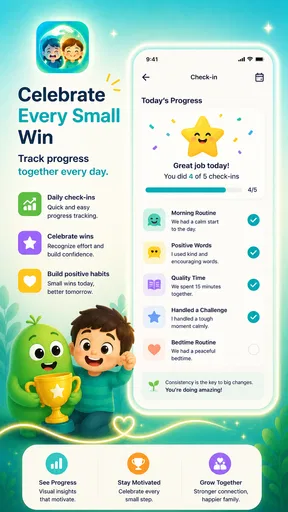
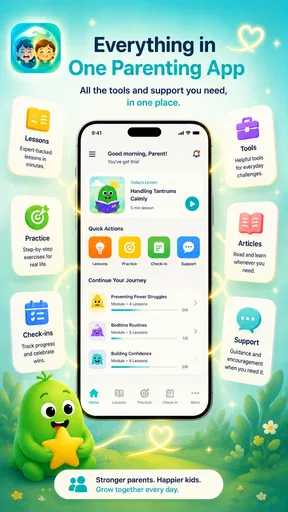
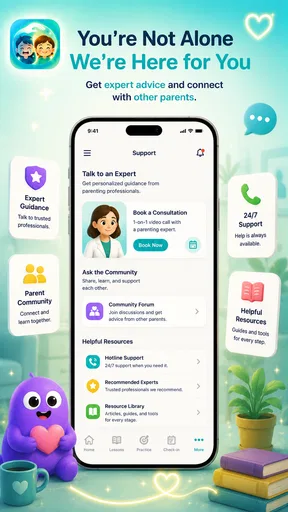
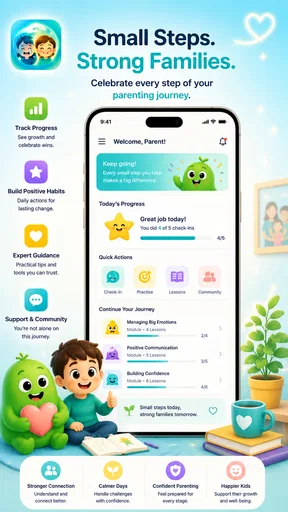
 Analysis by AppCompare
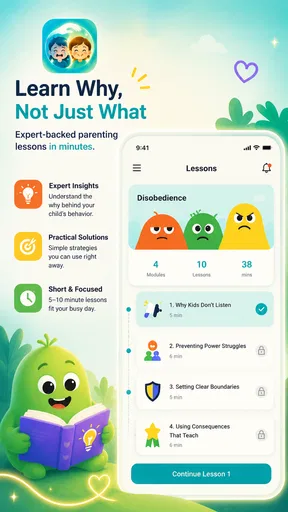
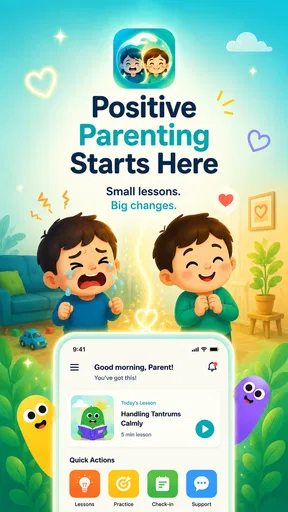
I came to Parenty - Child Behavior Guide looking for something more practical than a collection of parenting slogans. This free parenting app from Camille Labs takes a learning-and-reflection approach: instead of simply telling me what to do when a child is upset, it encourages me to understand behavior, practice possible responses, and think about what happened afterward. That makes it feel closer to a small coaching tool than a traditional article library.
The app is aimed at parents who want a calmer, more deliberate way to handle difficult moments. Its focus is not on tracking a child’s location, organizing family schedules, or replacing professional support. The useful question here is narrower and more realistic: can a parent build better habits for responding to challenging behavior? In my experience, Parenty is most valuable when I use it regularly and connect its lessons to situations that actually happen at home.
How I used Parenty as a repeatable parenting routine
The simplest way to approach the app is to create a baseline routine rather than open it only during a crisis. When a child is already shouting, refusing to get dressed, or melting down in a public place, I do not have the attention needed for a thoughtful lesson. I found it more useful to spend a quiet few minutes learning or reflecting, then apply one idea during the next ordinary interaction.
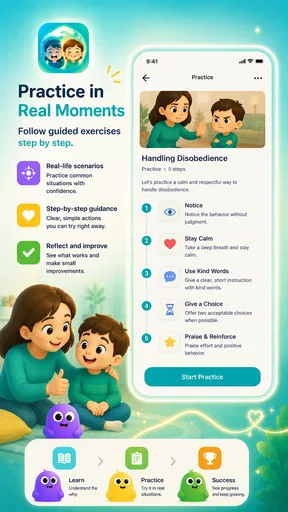
That workflow matters because the app’s subject is behavior management, not emergency intervention. I would read through a concept, consider how it related to a recent incident, and choose one response to try. Later, I could reflect on whether the response changed the tone of the interaction. This turns Parenty into a small practice loop: learn something, try it, notice the result, and adjust.
A realistic example is the evening transition from playtime to bedtime. A child may ignore repeated instructions, while the parent becomes increasingly direct and frustrated. Instead of treating the situation as a single failure, I would use the app’s learning approach to examine the trigger, my wording, the timing of the request, and the child’s reaction. The practical benefit is not a magical solution; it is the chance to replace automatic escalation with a more intentional response.
The strongest habit is to use the reflection step before the next difficult moment, not only after losing patience. Looking back can help identify patterns, but preparation is what makes a lesson usable. I recommend choosing one recurring situation—morning dressing, screen transitions, meals, homework, or bedtime—and keeping the experiment small. Trying to change every family rule at once would make it difficult to know what helped.
What the learning format does well
Parenty’s central idea is approachable because it combines learning with practice and reflection. Many parenting resources stop after explanation. They may describe a useful principle, but leave the reader wondering how to apply it when a child is tired, distracted, or angry. A practice-oriented app has a better chance of becoming part of daily life because it asks me to do something with the information.
Worth Reading Before You Choose

EA SPORTS FC Mobile 26 Is a Bigger Football Game, but It Takes Time

Flipboard Shows What News Apps Must Do Beyond the Feed

Switching to Android Auto Means Rethinking Your Driving Routine

Google Calendar Makes a Crowded Week Easier to Manage

Ludo King Makes the Most of the Minutes Between Plans

Baby Panda World Brings Quick Play to Modern Phones, but Its Game Library Feels Busy
I also appreciate that this format does not require a parent to sit through a long course in one session. The app works better as a regular check-in than as a book I finish and forget. Parents with limited time can focus on one lesson or one reflection at a time, then return when they have a relevant situation to consider.
That said, the value depends on the user’s willingness to be honest. If I use reflection only to confirm that my child was the problem, I lose much of the benefit. The more useful questions are uncomfortable but practical: Was my request clear? Did I give enough warning before the transition? Was I expecting behavior beyond the child’s current ability? Did my own stress make the situation worse?
Settings and choices worth checking first
There are no complicated configuration demands that define the experience, but I would still spend a moment checking how the app fits my routine. The important choice is not technical; it is deciding when and why I will use it. A parent who opens it only when overwhelmed may find the process too slow. A parent who sets aside a consistent moment can turn it into a useful learning habit.
I would also consider the age and developmental stage of the child before applying any suggestion. The app is rated for Everyone, but that rating describes the app’s accessibility, not a guarantee that every idea will suit every family or age group. A strategy that works with a preschooler may need different wording for an older child, and a response appropriate for a child with additional needs may require guidance beyond an app.
Another worthwhile setting is the level of commitment I expect from myself. Rather than promising to complete everything, I would choose a modest rhythm: one focused session, one real-life experiment, and one short review. This makes the app easier to sustain. Parenting tools often fail not because the content is useless, but because the routine around them is too ambitious.
Families sharing parenting responsibilities should agree on the specific behavior they are working on. If one adult is practicing calm, predictable instructions while another changes the rule from day to day, the child receives mixed signals. Parenty can support the learning conversation, but it cannot make parents use the same approach. The app is most effective when it becomes a prompt for coordination rather than a private scorecard.
Shortcuts that make the lessons more useful
The fastest pattern I found was to connect every session to a recent event. Instead of asking, “How can I become a better parent?” I would ask, “What happened during the last difficult transition, and what can I test next time?” That narrower question makes reflection concrete and prevents the app from becoming an abstract self-improvement exercise.
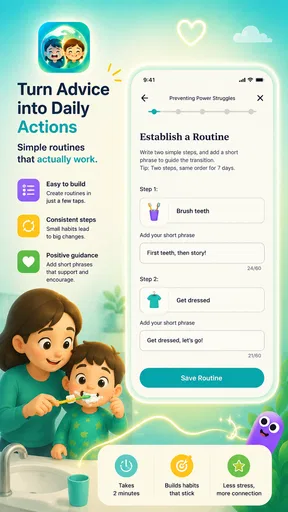
A second useful shortcut is to choose a single sentence or action to practice. For example, I might focus on giving a clear instruction once, offering a simple choice, or pausing before repeating myself. The point is not that one technique solves all behavior problems. The point is that a small, observable experiment lets me judge whether my response was clearer and calmer.
I would avoid opening the app in the middle of an argument unless I am already calm enough to use it productively. A phone can easily become another distraction, and a child may interpret the parent’s attention to the screen as avoidance. The better pattern is to use Parenty before a predictable challenge, or afterward when everyone has settled.
Another non-obvious advantage is that reflection can reveal environmental causes rather than only child behavior. If the same conflict appears when everyone is hungry, rushing, or switching activities without warning, the solution may involve changing the routine. Parenty’s learning-and-reflection structure is well suited to that kind of observation because it encourages me to look at the whole interaction instead of labeling the child.
For busy parents, I suggest keeping the app tied to an existing pause in the day. It could be after the child goes to sleep, during a quiet morning drink, or while waiting for an appointment. The exact moment is less important than making it repeatable. A routine that lasts a few minutes and actually happens is more useful than a detailed plan that never survives a busy week.
Where it fits beside ordinary parenting resources
Compared with searching the web after every difficult incident, Parenty offers a more focused path. Online searches can provide a huge range of opinions, but that variety can be overwhelming, and the first result is not always the most suitable for a particular family. An app centered on learning, practice, and reflection gives me a consistent place to return to instead of starting from zero each time.
Compared with a printed parenting book, the app feels easier to revisit in short sessions. A book may offer more depth and context, especially for a complex topic, but it is less convenient when I want to reflect on a specific event. Parenty is better suited to quick, repeatable engagement, while a book may be the stronger choice for a parent who wants a longer, carefully developed treatment of child development.
Compared with social media parenting advice, I prefer the app’s more private and deliberate feel. Social platforms can be encouraging, but they also invite comparison and oversimplification. Parenty is not a substitute for a qualified professional, yet its reflective approach is less likely to turn one family’s experience into a universal rule.
The trade-off is that a focused app may feel limited when I need help with a very specific concern. Parents dealing with persistent aggression, developmental questions, safety risks, trauma, or serious family stress should seek appropriate professional support rather than expecting a general behavior guide to handle everything. I would treat Parenty as a habit-building companion, not as an assessment tool or a clinical service.
What experienced use looks like
After repeated use, I would organize the experience around patterns rather than isolated incidents. If mornings are difficult, I would study the sequence: waking, eating, dressing, leaving, and the points where instructions become rushed. If bedtime is the issue, I would examine the transition from stimulating activity to a quieter routine. This approach makes the app more useful because the reflection is attached to a repeatable context.
I would also separate the child’s behavior from my goal for the interaction. Sometimes the goal is cooperation; sometimes it is safety; sometimes it is simply ending a power struggle without adding more distress. Those are different situations. A response that works for getting out the door may not be right for comforting a frightened child. The app can help me think more carefully, but I still need to choose the goal before judging whether an approach worked.
One important trade-off is consistency versus flexibility. Predictable responses help children understand boundaries, but rigidly applying a technique can ignore fatigue, illness, sensory overload, or an unusual family event. I would use Parenty to build a dependable baseline, then adapt it when the circumstances genuinely change. Consistency should not mean refusing to notice what is happening.
Another advanced habit is to reflect on the parent’s recovery, not only the child’s response. If I handled a moment poorly, the next useful step may be repairing the relationship, acknowledging my tone, and trying again. A behavior guide is more valuable when it supports ongoing learning rather than making parents feel they must perform perfectly. That is where the reflection element can become more meaningful than a simple list of techniques.
Limits, cost, and practical expectations
Parenty is free to install, which makes it easy to try without committing money first. It includes optional in-app purchases ranging from a few dollars to higher-priced items, so I would pay attention to any purchase screen and decide whether the available free experience is enough for my needs before spending. The presence of optional purchases does not automatically make the app poor value, but it does mean the free label should not be confused with every part of the experience being unlocked.
The app is currently at version 1.0.61 and requires Android 7.0 or later. That makes device compatibility a straightforward check before installing. I would also remember that the product is relatively young, having been released on October 28, 2025. A newer app can feel focused and uncluttered, but it may not yet have the breadth or refinement of long-established parenting resources.
Its audience reach is encouraging: the app has passed ten thousand installs and holds a 4.8 average from ninety-three ratings, with eight written reviews. Those figures suggest a positive early response, but I would not treat them as proof that it will suit every parenting style. A small, highly rated user base can show enthusiasm without answering every question about long-term use, different family structures, or challenging circumstances.
I would skip Parenty if I wanted a detailed child-development reference, a family calendar, a behavior chart with extensive tracking, or immediate professional advice. It is also not the right first step when a child’s behavior creates a safety concern or when the parent needs an individualized evaluation. In those cases, an app can support reflection later, but it should not delay direct help.
On the other hand, I would recommend trying it if I often react on autopilot and want a structured way to pause, learn, and practice. It is especially suitable for parents who prefer short guided exercises over long articles and who are willing to test one change at a time. The app’s value comes less from opening it once and more from returning to it with a real situation in mind.
My verdict after building a steady routine
Parenty - Child Behavior Guide works best as a quiet training partner for parents who want to improve their responses through repetition. Camille Labs has chosen a useful direction by combining education with practice and reflection instead of presenting parenting as a set of instant fixes. I found that approach more realistic than advice that assumes every child and every household will respond identically.
The app is not a replacement for a pediatrician, therapist, parenting class, or carefully researched book. Its guidance needs to be interpreted through the child’s age, temperament, needs, and the safety of the situation. The optional purchases also deserve attention, and the relatively recent release means I would keep expectations reasonable about how broad or mature the overall experience may be.
Still, the free entry point makes experimentation easy, and the Everyone rating keeps it accessible to a broad audience. If I were recommending it to a friend, I would say this: choose one recurring conflict, use the app before and after that situation, and judge it over several attempts rather than one dramatic evening. Used that way, Parenty can turn vague intentions—being calmer, clearer, or more consistent—into specific habits I can actually practice.
My final opinion is positive, with a clear condition: this is a tool for reflection and behavior practice, not a complete parenting solution. Parents who enjoy guided learning and want a repeatable routine should find it worthwhile. Those seeking diagnosis, deep specialist material, or extensive family management features will be better served elsewhere. For the right user, its greatest strength is simple but meaningful: it gives everyday parenting challenges a structure for learning from them instead of merely surviving them.
Pros
- Offers practical tips for handling common child behavior challenges.
- Helps parents respond more calmly and consistently in difficult moments.
- Advice is easy to read and suitable for busy caregivers.
- Can support better communication between parents and children.
- Useful as a quick reference before or after challenging situations.
Cons
- Guidance may feel too general for complex family circumstances.
- Some recommendations may not suit every parenting style or culture.
- It cannot replace advice from a pediatrician or child psychologist.
- Parents may need to adapt suggestions for different ages and needs.
- Limited value if users expect personalized
- one-to-one professional support.
FAQs for Parenty - Child Behavior Guide
What is Parenty - Child Behavior Guide designed to do?
Parenty - Child Behavior Guide is designed to help parents better understand children’s behavior and respond to everyday challenges with practical guidance. It may provide explanations, parenting suggestions, and behavior-focused resources for situations such as tantrums, defiance, emotional outbursts, routines, and communication difficulties. It should be viewed as an educational support tool rather than a replacement for individualized advice from a pediatrician, psychologist, or other qualified professional.
Is Parenty suitable for every child and parenting situation?
The app can be useful for parents and caregivers looking for general ideas about child behavior, but its recommendations may not apply equally to every child, age, family, or cultural situation. Children develop at different rates, and behavior can be influenced by health, neurodevelopment, family circumstances, and school experiences. Parents should use the content as a starting point, adapt suggestions thoughtfully, and seek professional guidance when concerns are persistent, severe, or affecting daily life.
Can Parenty diagnose behavioral or developmental conditions?
No. Parenty should not be treated as a diagnostic tool. Information in a behavior guide can help parents recognize patterns and prepare questions, but it cannot confirm conditions such as ADHD, autism, anxiety, depression, learning difficulties, or other medical and psychological concerns. Diagnosis requires a proper assessment by an appropriately qualified professional who can consider the child’s history, development, environment, and individual needs.
Does Parenty replace advice from a pediatrician or child psychologist?
It does not replace professional medical, psychological, or educational advice. The app may offer convenient explanations and practical parenting strategies, but it cannot evaluate a child directly or account for every relevant circumstance. Contact a pediatrician or mental-health professional if behavior changes suddenly, causes significant distress, involves aggression or self-harm, disrupts sleep or school, or raises concerns about the child’s safety or development.
What should parents check before downloading and using Parenty?
Before downloading Parenty, parents should review its store listing, supported device requirements, privacy policy, subscription or in-app purchase terms, and any information about how personal or family data is handled. It is also worth checking whether the content matches the child’s age and the parent’s needs. Avoid entering unnecessary sensitive information, and remember that app-based guidance works best alongside attentive parenting and trusted professional support when needed.


